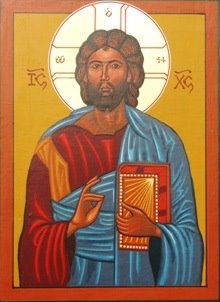
I was watching Sunday Night with Fr. Benedict Groeschel on EWTN & pondering what approach I will take toward presenting the Faith to my 6th graders this year. This meditation settled on me.
The Gospel calls us to a life of utmost joy in the Spirit of God. It calls us to achieve our ultimate fulfillment by contemplating & striving towards union with God. The call of the Gospel is a truly radical one – it calls us to truly be whom we are meant to be: “Man fully alive.” I know there are people who believe that man is nothing than an animal that lives a short, brutal life, & then finally dies; but I genuinely believe the vast majority of people recognize, but are scared to death of this call to such inconceivable glory, & so settle for a lower, more earthly calling which seems more graspable, both in thought & reality.
The world today calls us to a life of conformity & consumerism, to be consumed by the things that we are assured we must have if we want to be happy. Yet isn’t there always a new thing to have? So this happiness is always a step beyond us. The world wants to force you into certain channels, certain mindsets, & certain lifestyles where it neutralize your will & freedom, & drain you of your humanity & your money. In the world we engage in projects that, while possibly good in themselves & can bring temporal success, are easily turned into idols that consume us & draw us away from the only thing that ultimately matters, our immortal souls’ communion with God.
I know this is not said well & that there is much more to say, but I want to teach this to my students in some way. Through the grace of God, I just barely escaped the jaws of the world, & I’m not out of the woods yet. I hope they will not fall for false & destructive happinesses, but recognize & cling to the happiness of God for their whole lives.
Monday, October 31, 2011

Wednesday, October 19, 2011
Hymns of the Breviary - Jam Morte Victor

Perfect for the Rosary month of October - a hymn in honor of the Glorious Mysteries from Hymns of the Breviary...
Jam Morte Victor by Fr. Augustine Ricchini, O.P.
Now Christ, the Conqueror of death,
Breaks sin's enslaving chain,
And rising from the tomb returns,
And opens heaven again.
Awhile beheld by mortal men,
He rises from their sight;
Ascending to the Father's throne,
He reigns in equal light.
His promised gift unto His own
He sends forth from above,
And rains the Holy Spirit down
In fiery tongues of love.
The Virgin, freed of mortal weight,
Is borne than stars yet higher,
And with glad melody is hailed
By each Angelic choir.
Our Mother's gentle brow now shines
With crown in starry sheen,
As nigh her Son, in light enthroned,
She reigns creation's Queen.
O Jesu, born of Virgin bright,
All glory be to Thee,
With Father and with Paraclete,
Through all eternity.
Wednesday, October 12, 2011
In the Beginning by J. Ratzinger - Homily 4, Part 2
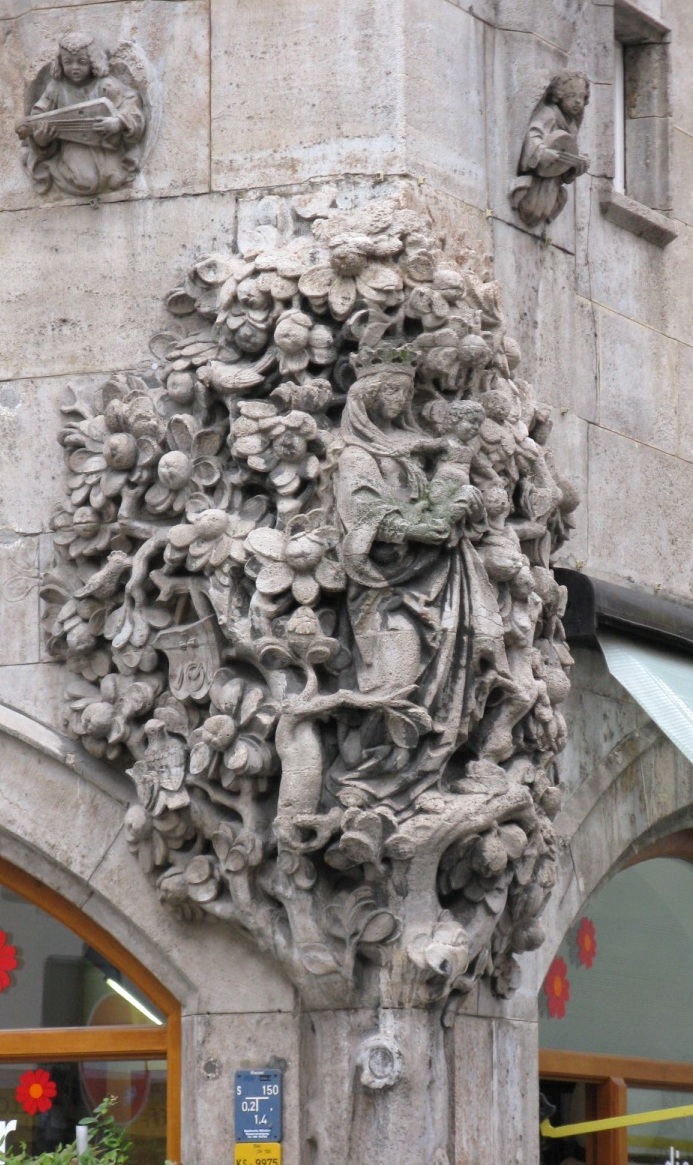
The first Adam through his disobedience brought
a legacy of sin & death upon all his children, who to this day have continue
to seek a replacement for God & to build a paradise on earth without his
help, an effort that always brings hellish tragedy & leaves man himself degraded. The New Testament offers a remedy for our
situation.
As noted earlier, the Church reads the Old
Testament, not exclusively for its own sake, but as the story of God’s
revelation of himself to his people, a revelation fulfilled in the person of
Jesus Christ. Therefore, we can see that
the catastrophic fall of the first Adam into sin & death in the Old
Testament gives way to the atoning sacrifice of the second Adam in the New, a
sacrifice that reconciles God & man & brings new life. Man was originally created to be in a
relationship of love with God; in Christ, this relationship is not only possible
again, but reaches new & previously unimagined heights.
Ratzinger notes that, “Jesus Christ goes Adam’s
route, but in reverse. In contrast to
Adam he is really “like God.” But this
being like God… is being a Son, & hence it is totally relational… Therefore
[he] does not hold graspingly to his autonomy… [but] he becomes a slave… he
does not go the route of power but that of love (p.75).” So, from the beginning, man has asked “Who am
I?” “What is my purpose?” “Does my life have meaning?” “For what was I made?” Not “for what,” but “for whom.” He was not made to be alone or
autonomous. He is made to be a son, even
a son of God.
But how can the new Adam undo the damage caused
by the first one & bridge the chasm between God & man? How do we receive our sonship? The answer is the Cross: “…the place of
[Christ’s] obedience, is the true tree of life…. now approachable… and… the
true pole of the earth, by which it is itself once more set aright (p.76).” The first man was not allowed to eat of the
fruit of the tree of life lest “he live forever (Gen 3:22),” but now by way of
Christ’s obedience, man is welcomed to approach the divine. His destiny in Christ is now to be “partakers
of the divine nature (2 Pet 1:4).”
And now, something quite surprising: “Therefore
the Eucharist, as the presence of the cross, is the abiding tree of life, which…
to receive it, to eat of the tree of life, thus means to receive the crucified
Lord & consequently to accept… his life, his obedience, his ‘yes’… It means
to accept the love of God… our truth – that dependence on God which is no more
an imposition from without than is the Son’s sonship. It is precisely this dependence that is
freedom, because it is truth & love (pp.76-77).”
Were you expecting that!?! To start with the words of the creation of
the world & end up with the Flesh & Blood of Christ Jesus in the
Eucharist that is offered & received at every Mass? Will this change your view of the sacred
Scriptures? The way that you approach
Holy Communion? Your relationship with
God? Ratzinger ends his fourth homily with
the hope that his listeners “be touched by the words of Jesus in their
entirety: ‘The kingdom of God is at hand; repent, and believe in the gospel’
(Mark 1:15).”
Friday, October 7, 2011
Victory!

Note Pope St. Pius V at the left, leading the Catholic world in praying the Rosary for Our Lady's intercession for victory against the Turks.
Meditating on the Gospel events of Jesus in the Rosary will surely secure our victory over those enemies that seek to separate us from Christ, as well.
These photos were taken at one of the most glorious places on earth: the Basilica Notre Dame de Fourvier overlooking Lyon, France.


Sunday, October 2, 2011
See the golden sun arise!
 A beautiful hymn for Thursday Lauds taken from the book Hymns of Breviary
Lux ecce surgit auria
See the golden sun arise!
Let no more our darkened eyes
Snare us, tangled by surprise
In the maze of sin!
From false words and thoughts impure
Let this Light, serene and sure,
Keep our lips without secure,
Keep our souls within.
So may we the day-time spend,
That, till life's temptations end,
Tongue, nor hand, nor eye offend!
One, above us all,
Views in His revealing ray
All we do, and think, and say,
Watching us from break of day
Till the twighlight fall.
Unto God, the Father, Son,
Holy Spirit, Three in One,
One in Three, be glory done,
Now and evermore.
- Prudentius (d.413)
Sunday, September 25, 2011
Confucius says...
More pithy bits of wisdom from the Analects of Confucius:
I. Si-ma Niu appeared worried, saying, "All men have brothers. I alone have none."
Zi-xia said, "I have heard it said: life and death are a matter of Destiny; wealth & honour depend on Heaven. The gentleman is reverent & does nothing amiss, is respectful towards others & observant of the rites, and all within the Four Seas are his brothers. What need is there for the gentleman to worry about not having any brothers?" (12:5)
II. The Master said, "In hearing litigation, I am no different from any other man. But if you insist on a difference, it is, perhaps, that I try to get the parties not to resort to litigation in the first place." (12:13)
III. Fan Chi was in attendance during an outing to the Rain Altar. He said, "May I ask about the exaltation of virtue, the reformation of the depraved and the resolution of perplexities?"
The Master said, "What a splendid question! To put service before the reward you get for it, is that not exaltation of virtue? To attack evil as evil and not the evil of a particular man, is that not the way to reform the depraved? To let a sudden fit of anger make you forget the safety of your own person or even that of your parents, is that not being perplexed?" (12:21)
IV. Fan Chi asked about benevolence. The Master said, "Love your fellow men." He asked about wisdom. The Master said, "Know your fellow man." Fan Chi failed to grasp this meaning. The Master said, "Raise the straight over the crooked. This can make the crooked straight." (12:22)
V. The Master said, "If a man is correct in his own person, then there will be obedience without orders being given; but if he is not correct in his own person, there will not be obedience even when orders are given." (13:6)
VI. The Master said, "The gentleman is at ease without being arrogant; the small man is arrogant without being at ease." (13:26)
VII. The Master said, "There are three things constantly on the lips of the gentlemen none of which I have succeeded in following: 'A man of benevolence never worries; a man of wisdom is never of two minds; a man of courage is never afraid.'" (14:28)
VIII. The Master said, "The gentleman is ashamed when the words he utters outstrip his deeds." (14:27)
I. Si-ma Niu appeared worried, saying, "All men have brothers. I alone have none."
Zi-xia said, "I have heard it said: life and death are a matter of Destiny; wealth & honour depend on Heaven. The gentleman is reverent & does nothing amiss, is respectful towards others & observant of the rites, and all within the Four Seas are his brothers. What need is there for the gentleman to worry about not having any brothers?" (12:5)
II. The Master said, "In hearing litigation, I am no different from any other man. But if you insist on a difference, it is, perhaps, that I try to get the parties not to resort to litigation in the first place." (12:13)
III. Fan Chi was in attendance during an outing to the Rain Altar. He said, "May I ask about the exaltation of virtue, the reformation of the depraved and the resolution of perplexities?"
The Master said, "What a splendid question! To put service before the reward you get for it, is that not exaltation of virtue? To attack evil as evil and not the evil of a particular man, is that not the way to reform the depraved? To let a sudden fit of anger make you forget the safety of your own person or even that of your parents, is that not being perplexed?" (12:21)
IV. Fan Chi asked about benevolence. The Master said, "Love your fellow men." He asked about wisdom. The Master said, "Know your fellow man." Fan Chi failed to grasp this meaning. The Master said, "Raise the straight over the crooked. This can make the crooked straight." (12:22)
V. The Master said, "If a man is correct in his own person, then there will be obedience without orders being given; but if he is not correct in his own person, there will not be obedience even when orders are given." (13:6)
VI. The Master said, "The gentleman is at ease without being arrogant; the small man is arrogant without being at ease." (13:26)
VII. The Master said, "There are three things constantly on the lips of the gentlemen none of which I have succeeded in following: 'A man of benevolence never worries; a man of wisdom is never of two minds; a man of courage is never afraid.'" (14:28)
VIII. The Master said, "The gentleman is ashamed when the words he utters outstrip his deeds." (14:27)
Monday, September 19, 2011
When being subjective is not subjective at all
I was watching one of these new, hip investigative cop shows called The Mentalist, in which the main character who has an uncanny gift for reading people is thrown into prison & quickly confronted by the meanest & nastiest of all the inmates. He catches tough guy off guard with this observation:
Before too long, the inmate is pouring out his heart & soul to his new buddy.
When I told my mom I was studying philosophy, she replied, "Everyone has a philosophy." Well, that's true. Maybe not everyone has thought it through explicitly, but everyone approaches life with a certain set of assumptions, presuppositions, goals, & methods. We all do it.
Something the nineteenth century brought us besides the industrial revolution & the first modern war was a crap load of really, really bad philosophy. Much of this has not only become popular, but imbued into Western culture at large. It's been so successful that it's hard to recognize it because it's already so close to us.
One such example is subjectivism, which perhaps we can trace back to Protagoras, who famously quipped, "Man is the measure of all things, of things that are that they are, of the things that are not that they are not." In other words, believing it so makes it so. Subjectivism is a kind of indulgence into one's own viewpoint. It's not a very happy place; it doesn't let in any light or air from the outside - you know, the place where, like, real stuff comes from. It also both excludes others & also concedes them their own subjectivistic territory all at the same time. If you can make your own reality, can't everyone else? And aren't all these 'realities' all equally valid? If someone hits you up with, "Well, maybe that's true for you, but not for me," then you've just been subjectivism'd on.
Now, the thing is, Subjectivity is a very good thing, so don't confuse them. Subjectivity means being who you really are, being the subject of your actions, anchored in your own being, not easily swayed & manipulated by the myriad of other things that come your way. Subjectivity allows you to see other things as they really are, too, & to approach (or avoid) them in a healthy way. It is a state of giving yourself & others their proper due. It is when you are Subjective that you are really Objective. Conversely, when you are incarcerated in subjectivism, you only get a distorted view of things, not really understanding them at all. So, from a Subjective standpoint, one could reply, "No, some things really are good in themselves regardless of how dismissive one feels about them, & other things really are horrible no matter how much one indulges in them."
Many of the 'new' philosophical schools had as their expressed aim to turn the old order upside-down. Well, it's very nearly succeeded, wouldn't you say! Subjectivism, especially, is dangerous because it says that everybody's truth is equally true, which really means "There is no Truth." It is a logical fallacy to say that 2+2 is both 4 & 7 at the same time. Only one of these propositions is true. Chesterton wisely noted that when one stops believing in something, he doesn't believe in nothing; rather he'll believe in anything. "Maybe it's 4 for you, but not for me."
In Chesterton's time, these new philosophies were radical. The Czar & his family had been executed by Communist. The Spanish civil war raged. National Socialism & fascism were on the rise in Germany & Italy. Margaret Sanger was doing her diabolical work here in the U.S. These ideas were audacious & gaudy & dangerous. Today, they've soaked into the societal fabric. We often grant others their own reality as way of being polite & maintaining order. People are scared to speak up, even when something rings through as a universal truth - like the idea of owning another human being as property, for example.
Just keeping your eyes & ears open is enough to develop a BS-detector for subjectivism. It will help root out a lot of bad philosophy - & unhappiness. The Truth of every situation may not be clear, but not up for grabs or for a vote, either. Chesterton also reminded us that the Truth is the Truth even if no one believes it, & lies are still lies even if everyone believes them. We have to be vigilant. As another popular TV show proposed, The Truth is out there...
"If you stopped looking at the world in terms of what you like & don't like, & instead saw things for what they are in themselves, you would find a lot of peace, my friend."
Before too long, the inmate is pouring out his heart & soul to his new buddy.
When I told my mom I was studying philosophy, she replied, "Everyone has a philosophy." Well, that's true. Maybe not everyone has thought it through explicitly, but everyone approaches life with a certain set of assumptions, presuppositions, goals, & methods. We all do it.
Something the nineteenth century brought us besides the industrial revolution & the first modern war was a crap load of really, really bad philosophy. Much of this has not only become popular, but imbued into Western culture at large. It's been so successful that it's hard to recognize it because it's already so close to us.
One such example is subjectivism, which perhaps we can trace back to Protagoras, who famously quipped, "Man is the measure of all things, of things that are that they are, of the things that are not that they are not." In other words, believing it so makes it so. Subjectivism is a kind of indulgence into one's own viewpoint. It's not a very happy place; it doesn't let in any light or air from the outside - you know, the place where, like, real stuff comes from. It also both excludes others & also concedes them their own subjectivistic territory all at the same time. If you can make your own reality, can't everyone else? And aren't all these 'realities' all equally valid? If someone hits you up with, "Well, maybe that's true for you, but not for me," then you've just been subjectivism'd on.
Now, the thing is, Subjectivity is a very good thing, so don't confuse them. Subjectivity means being who you really are, being the subject of your actions, anchored in your own being, not easily swayed & manipulated by the myriad of other things that come your way. Subjectivity allows you to see other things as they really are, too, & to approach (or avoid) them in a healthy way. It is a state of giving yourself & others their proper due. It is when you are Subjective that you are really Objective. Conversely, when you are incarcerated in subjectivism, you only get a distorted view of things, not really understanding them at all. So, from a Subjective standpoint, one could reply, "No, some things really are good in themselves regardless of how dismissive one feels about them, & other things really are horrible no matter how much one indulges in them."
Many of the 'new' philosophical schools had as their expressed aim to turn the old order upside-down. Well, it's very nearly succeeded, wouldn't you say! Subjectivism, especially, is dangerous because it says that everybody's truth is equally true, which really means "There is no Truth." It is a logical fallacy to say that 2+2 is both 4 & 7 at the same time. Only one of these propositions is true. Chesterton wisely noted that when one stops believing in something, he doesn't believe in nothing; rather he'll believe in anything. "Maybe it's 4 for you, but not for me."
In Chesterton's time, these new philosophies were radical. The Czar & his family had been executed by Communist. The Spanish civil war raged. National Socialism & fascism were on the rise in Germany & Italy. Margaret Sanger was doing her diabolical work here in the U.S. These ideas were audacious & gaudy & dangerous. Today, they've soaked into the societal fabric. We often grant others their own reality as way of being polite & maintaining order. People are scared to speak up, even when something rings through as a universal truth - like the idea of owning another human being as property, for example.
Just keeping your eyes & ears open is enough to develop a BS-detector for subjectivism. It will help root out a lot of bad philosophy - & unhappiness. The Truth of every situation may not be clear, but not up for grabs or for a vote, either. Chesterton also reminded us that the Truth is the Truth even if no one believes it, & lies are still lies even if everyone believes them. We have to be vigilant. As another popular TV show proposed, The Truth is out there...
Subscribe to:
Posts (Atom)